Visitors to the Grand Rapids Public Museum in 2026 will likely find a new exhibit to explore; “Backyard Adventures”. Found on the second floor of the museum in the space where “Fashion + Nature” used to reside, “Backyard Adventures” is a traveling exhibit that opened at the Grand Rapids Public Museum on January 24, 2026.
Created by Scitech Discovery Center, a science museum based in Perth, Australia, “Backyard Adventures” is a traveling exhibit aimed towards children ages 5 to 12 that is working to teach scientific topics through the lens of how these ideas relate to ones backyard. By relating abstract scientific concepts, such as the food web and physics, to everyday facets of people’s lives, such as a local pond or a backyard mini golf set, “Backyard Adventures” better teaches these concepts to museum visitors. According to Stephanie Ogren, Vice President of Science & Education at the Grand Rapids Public Museum, this is something that is often done at the museum. “We always try to make thing relatable, either to your own home or to your own community. So even if we have an exhibit that’s about safari and African wildlife, we always try to say “what can you see here that’s like that or what types of conservation activities are happening here.” The museum always tries to tie things back and make them relatable for the community in Grand Rapids and West Michigan.” she says.
As stated before, “Backyard Adventures” is a traveling exhibit. This means that, unlike something like the previous “Nature + Fashion”, which was produced by the Grand Rapid Public Museum’s curation teams for use locally, “Backyard Adventures” was created by a separate institution, in this case Scitech, and now goes from museum to museum. As for the process of selecting a traveling exhibit for the Grand Rapids Public Museum, Dr. Ogren explains, “We have a committee that works through opportunities, there’s actual companies that sell or rent traveling exhibits, and we work with many of those. A lot of times we’ll book exhibits three years out.” One factor that is taken into account when deciding upon a new traveling exhibit to host at the Grand Rapids Public Museum is how well the potential exhibit would complement other traveling exhibits. “We always try to have really diverse exhibits that speak to different age groups, different demographics, so we might have a really science heavy exhibit and then we’ll that with a culture exhibit, or a play heavy exhibit we might pair with a more serious exhibit.”
One major focus in the exhibit in terms of design is on interactivity. “… there’s a lot of hands on activities, a lot of allowing people to create their own experience.” states Dr. Ogren. One of the major motives behind this focus is that the exhibit aims to encourage visitors to embrace a new attitude of curiosity about the world around them. “The exhibition focuses on seeing the unseen and taking a closer look at the world around you. The exhibition draws the visitor into the garden, making them more aware of their local world and how things interact, operate and live in that environment.” reads the educator’s guide for the exhibit. Having visitors actively interact with the exhibit as opposed to more static exhibits can help encourage this sense of curiosity. Another reason for this emphasis on interactivity is to encourage people to use their imaginations. “… in the exhibit you’ll see your backyard or you’ll see a shed or you’ll see something that is a dark area, and then it’ll ask you to imagine what you might see at night, and then you can think of bats and frogs or those types of animals that come out at night. There’s a lot more imagination and a lot more play. We would like all age groups to have good imaginations and good play.” explains Dr. Ogren.
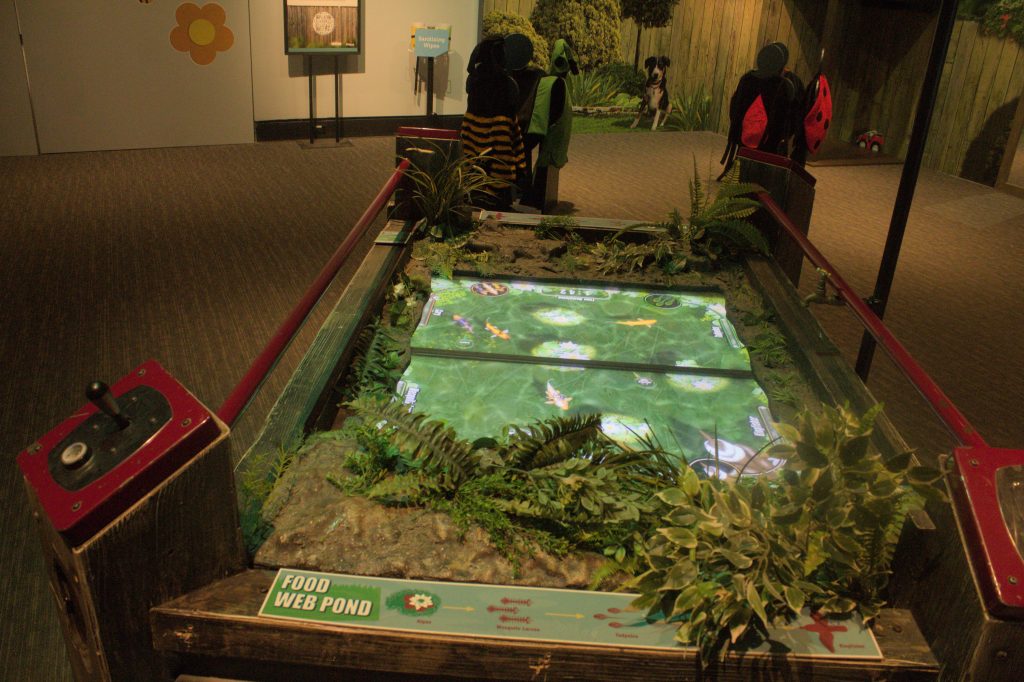
In terms of specific topics, one major field of science that is explored in the exhibit is biology. A facet of this field that is explored in the exhibit is ecology, the study of how organisms interact with each other and their environment. One of the first parts of the exhibit that visitors will come across is the “Night Vision” station, which presents some animals people might see that are nocturnal, meaning that they are primarily active after the sun sets. Some species that are presented include Barn Owls (Tyto alba), Brown Rats (Rattus norvegigus), and the North American Opossum (Didelphis virginiana). Another portion of the exhibit that covers ecology is the “Food Web Pond”. A food web describes the flow of energy through a natural habitat, such as a forest or a backyard garden, by mapping the various predator-pray relationships in an ecosystem. In this case, the exhibit uses a simplified line of algae to mosquito larvae to tadpoles to carp to kingfishers. Here, visitors are encouraged to use joysticks and buttons to play as one of these four groups.
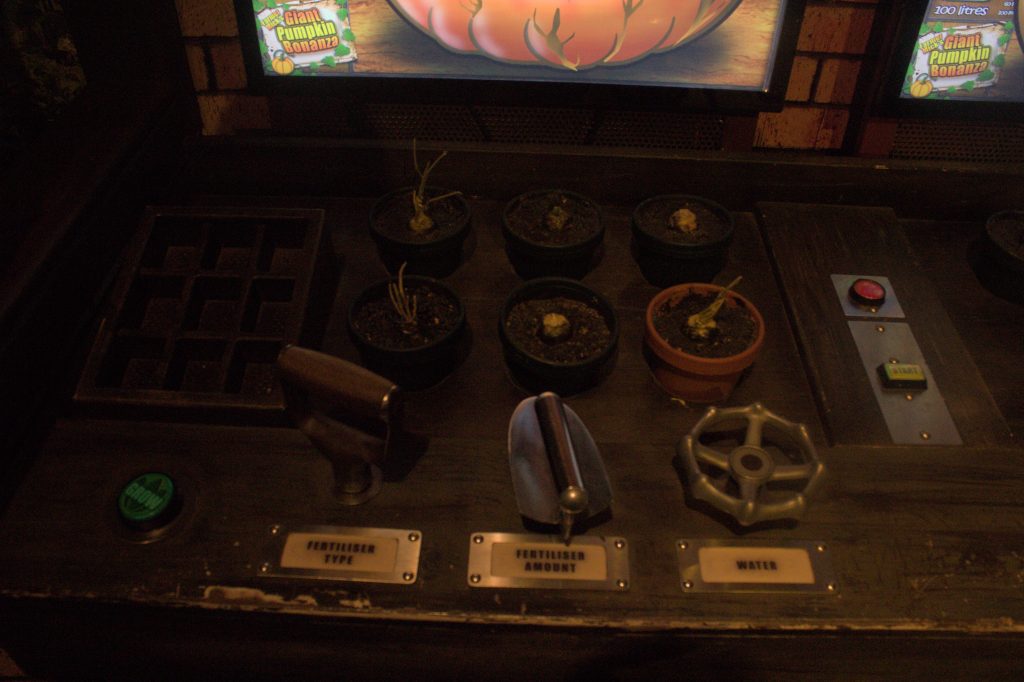
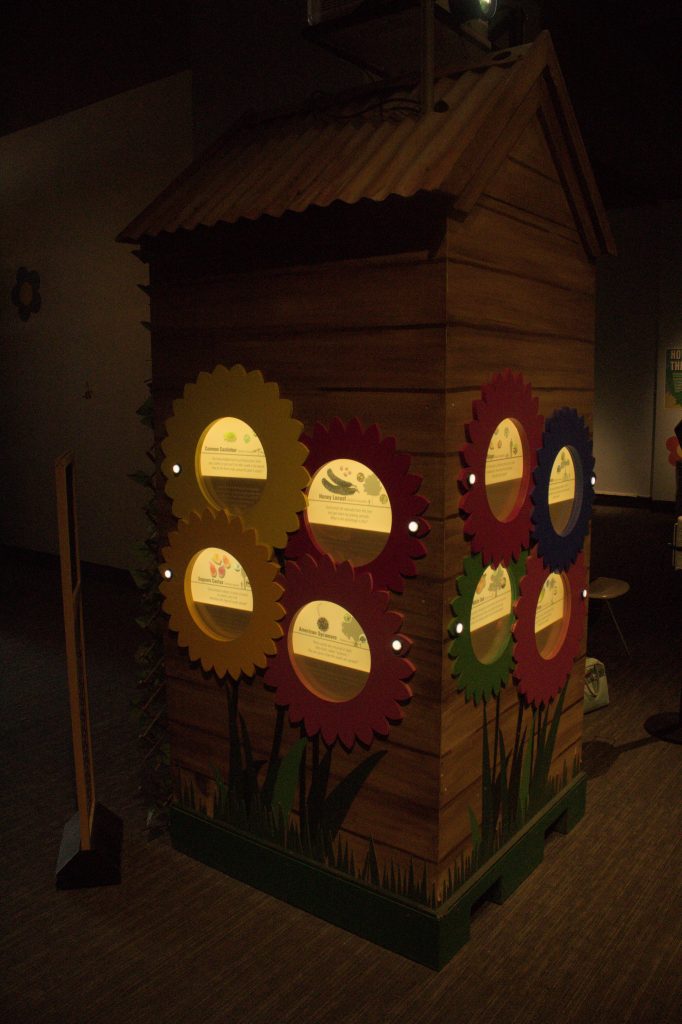
Botany, another facet of biology that covers the study of plants, is another focus of the the exhibit. One portion of the exhibit that focuses on the study of botany is the “Giant Pumpkin Bonanza” station. In this game, visitors are put in the role of a gardener trying to grow a record breaking pumpkin. To accomplish this, visitors are given the ability to control what type of fertilizer is given to the plant, how much is used, and how much water the plant receives, which helps visitors learn topics such as the types of elements plants need to grow. Another station is “Seed Dispersal” which, as the name implies, focuses on the various ways plants spread their seeds. These include palm trees, which float their coconuts on the ocean currents, dandelions, which spread their seeds with white fluffs which get caught on the wind, and fruit trees, which rely on animals to spread their seeds after they eat said fruit.
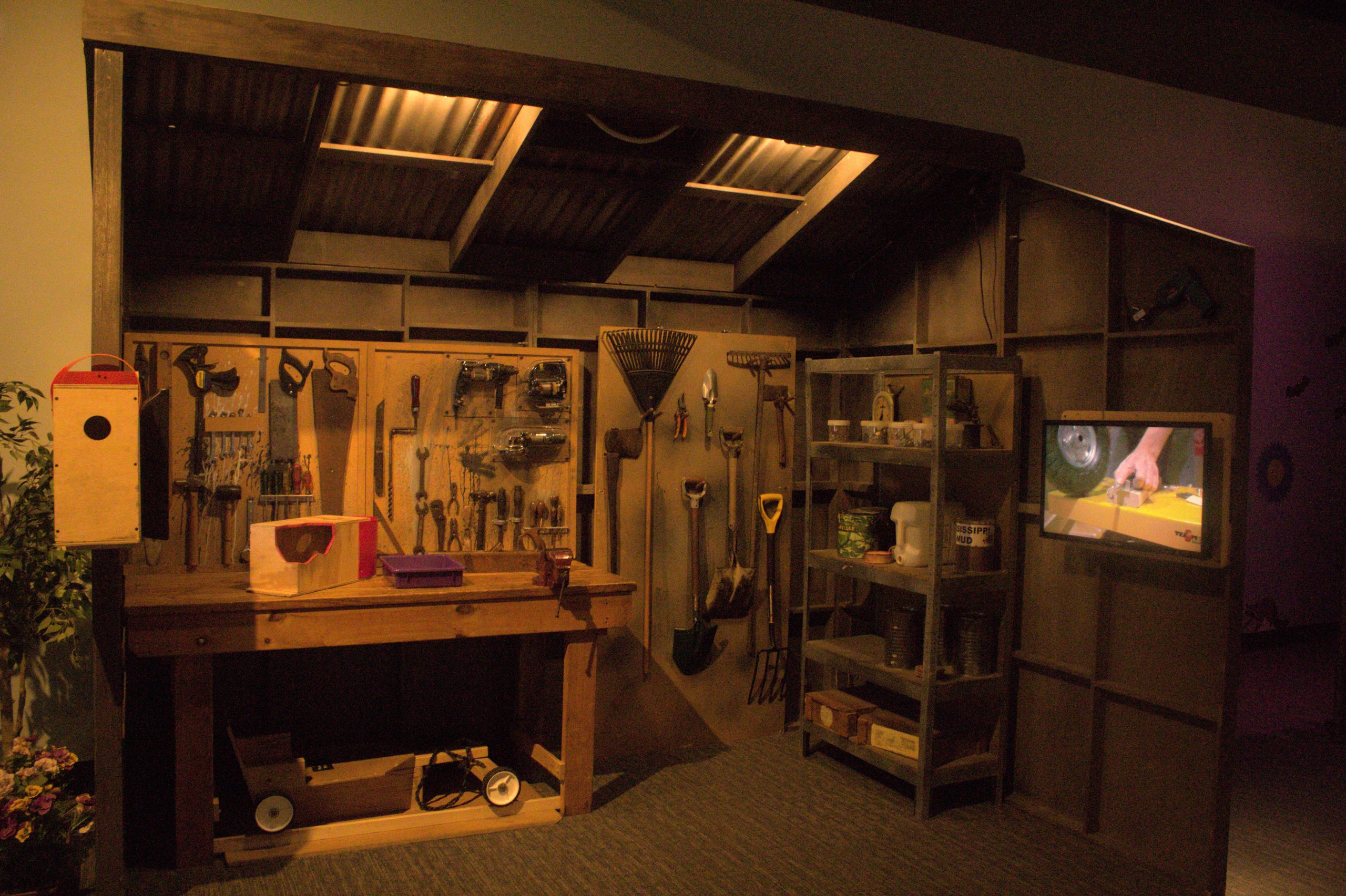
The exhibit also explores other fields of science outside of biology. Engineering is explored at “The Garden Shed”, visitors learn about how multiple famous inventions people know and love today started in sheds, with the station coming complete with build areas for people to try building things with provided materials and diagrams for how to build a go cart and a bird box at home with wood and basic tools. The exhibit also explores mathematics by framing geometry through the lens of paving stones, with visitors being encouraged to figure out how to fit together tiles of various shapes. One notable concept of geometry taught through this exhibit is that of tesselation, which describes an arrangement of 2D shapes that form a pattern upon a flat plane without any overlaps or gaps.
Museum visitors can enjoy a trip to “Backyard Adventures” until September 6, 2026. The GRPM also recommends people take a look at their summer camp programs and at Grand Rapids Whitewater’s Science and Leadership Program held in partnership with the GRPM.