For centuries, the night sky has sparked wonder in the hearts of humankind. Rather it be ancient star watchers drawing constellations in the sky to academics rigorously studying the cosmos with advanced technology, the stars, planets, and galaxies that reveal themselves when the lights go out have always been of great interest. Recently, these fixtures of the night sky have been joined by a new visitor; 3I/ATLAS, an interstellar comet.
3I/ATLAS, however, is different. 3I/ATLAS is what’s known as an interstellar comet. This means that the comet originates from outside of our Solar System. According to NASA, we know of it’s extrasolar origin from it’s orbital path. Unlike normal comets, whose trajectories can be traced as a complete orbit around our sun, 3I/ATLAS has a hyperbolic orbit. This means that it’s path can be represented as a line that gets curved by our sun’s gravitational pull.
Image Credit: NASA/Southwest Research Institute
This status as an interstellar comet makes 3I/ATLAS very interesting for researchers. This is largely due to the extremely rare nature of these types of celestial bodies, with 3I/ATLAS is only the third interstellar object to have ever been found passing through the Solar System. This, in part, is due to the difficulty involved in detecting such objects. According to David DeBruyn, Curator-emeritus of the Roger B. Chaffee Planetarium and former member of the board of the Grand Rapids Amateur Astronomical Association, “…these things have probably been flying through the Solar System for a very long time, and it’s not that unusual. It’s just that now we have the instrumentation and the survey techniques to pick them up.”
This interest has motivated researchers, such as those at NASA, to devote attention to studying the comet before it leaves. This can be seen in the variety of telescopic tools and observatories that have turned to view 3I/ATLAS, such as the James Webb Telescope, the Perseverance Rover, and the Psyche spacecraft. The images have revealed multiple facts about 3I/ATLAS. One particular topic of interest is the composition of the comet. According to Dr. Lauren Woolsey, a professor of astronomy at Grand Rapids Community Collage, “… the chemical makeup, so what elements are present and how much of each of those elements, is going to be slightly different than our Solar System because it formed from a collection of material that would be very similar to but not identical to our Solar System. Often, when we’re studying comets or asteroids; anything that we’ve sent small satellites to orbit or land on, they are object that we know formed with our Solar System and they’re giving us clues about our Solar System’s past and the chemical makeup of it. This one is different because it formed in a slightly different area, so a slightly different cloud of gas and dust.”
She goes on to elaborate, “…it’s giving us a sense of being able to compare and contrast our Solar System and rather it is a standard assortment of elements or if there is anything unique to either our Solar System or unique to this particular object.” One notable feature found in this regard is heightened levels of diatomic carbon (C2). This particular type of carbon contributes to a signature green color of the comet when heated. DeBruyn also noted that 3I/ATLAS is rich in substances like carbon monoxide, unlike comets from our solar system, which are chiefly made of ice.
Image Credit: International Gemini Observatory/NOIRLab/NSF/AURA/Shadow the Scientist. Image Processing: J. Miller & M. Rodriguez (International Gemini Observatory/NSF NOIRLab), T.A. Rector (University of Alaska Anchorage/NSF NOIRLab), M. Zamani (NSF NOIRLab
One misconception that both Dr.Woolsey and Mr. DeBruyn made a point of discouraging is speculation about the comet being an extraterrestrial spacecraft. There is no credible scientific evidence regarding an intelligent source of 3I/ATLAS. “All the evidence suggests that this is merely a vagabond comet.”succinctly puts DeBruyn. This misconception has, in part, been spread by previous coverage of the comet. “It goes without saying that a lot of media coverage has been speculation about intelligence or extraterrestrial origins and I think that’s very harmful speculation that is based on no evidence” explains Dr. Woolsey.
Night sky image I took (3I/ATLAS not necessarily included)
For Grand Rapidians who wish to try and view 3I/ATLAS, the best chance to view the comet would be to get to a dark region and to view it through a telescope, since it’s too faint to see with the naked eye. Specifically, one would be able to view the comet near the constellation Leo. However, when asked, David DeBruyn said that he knew of no successful sightings in the area, even among members of the GRAAA. Even so, he also mentioned that the winter night sky, due to the rotation of the Earth, is vastly different from the summer. This includes brighter stars than that of the summer, meaning that any hopeful 3I/ATLAS viewers won’t leave empty handed.
…
Thank you for reading to the end! Special thanks to Dr. Lauren Woolsey and David DeBruyn for talking with me about the comet. This is an extended edition of a story I wrote for The Rapidian, which you can read here.
Featured Image Credit: NASA, ESA, D. Jewitt (UCLA); Image Processing: J. DePasquale (STScI)
In the past few months, the Grand Rapids Public Museum has been getting in the mood for paleontology with two new exhibits, Tyrannosaurs: Meet the Family, a traveling exhibit that will be hosted by the Grand Rapids Public Museum until April 26, 2026, and the Clapp Family Mastodon, a new exhibit featuring a mastodon found in Kent County.
Tyrannosaurs: Meet the Family is a traveling exhibit, meaning that the exhibit is moved from institution to institution as opposed to being stationed at a single museum permanently. In this case, Tyrannosaurs: Meet the Family is organized by the Australian Museum, who have hosted exhibits at the Grand Rapids Public Museum such as Sharks, which left the GRPM at the end of August.
The tyrannosaurs were defined by a few key features. According to the educator’s guide for Tyrannosaurs: Meet the Family, tyrannosaurs were unique in having their nasal bones be fused, helping their skull withstand their strong bites. To complement this, the tyrannosaur family had unique D-shaped teeth at the front of their mouths. These teeth were somewhat analogous to our incisors, helping scrap and pull meat off of captured prey.
Tyrannosaur legs and hips also had a couple of unique features. At the top of their hips, they had a rib of bone that served as an attachment point for strong leg muscles. Their legs were also noticeably longer legs then other predatory dinosaurs.
When walking into the museum, visitors are greeted by a cast skeleton of Scotty, the most massive Tyrannosaurus rex to have ever been discovered and the largest dinosaur discovered in Canada. Surrounding the skeleton are other Tyrannosaurus rex fossils, helping to illustrate some interesting findings found in the research of this Late Cretaceous predator, such as how younger individuals had longer and leaner legs, suggesting that they may have hunted differently from the adults.
Tyrannosaurs: Meet the Family, as the name suggests, is not merely about the well known Tyrannosaurus Rex, but rather celebrates the Tyrannosaur family as a whole. This is arguably most exemplified by the entrance to the main exhibit on the third floor, where visitors are greeted by Guanlong wucaii. This Late Jurassic is wildly different from the titanic Scotty in the main hall, being a relatively small dinosaur with long arms, a covering of feathers, and a prominent crest on it’s snout.
Alongside this early member of the Tyrannosaurs, many cast skeletons of Tyrannosaur species are present in the exhibition hall, ranging from Dilong paradoxus, a small, Chinese species that was the first Tyrannosaur to be discovered with feathers, to more typical representatives of the group such as Albertosaurus sarcophagus and Daspletosaurus torosus. These exhibits are complemented by a variety of real fossils and interactive stations, such as a grip test that lets visitors compare their strength to a Tyannosaurus rex bite.
The exhibit also explores how dinosaur’s evolved into their only surviving forms; the birds. The exhibit explains how small theropods such as Velociraptor mongoliensis eventually evolved into the birds of modern day. The exhibit even has skeletons of non-avian dinosaurs next to the skeletons of birds such as Dromornis stiatoni and the domestic chicken in order to show visitors the similarities between the two.
When asked about the importance of traveling exhibits, Dr. Cory Redman, GRPM’s science curator, said, “It keeps the museum fresh.” He goes on to elaborate, “It means for most people, every time they come to the museum there’s gonna be something new to see. We are working on a big redesign project and so we’re working on redesigning our core exhibits … we don’t have the staff to redo our core exhibits that frequently.”
Dr. Redman also led the excavation of the star of another GRPM paleontological exhibit that opened recently, the Clapp Family Mastodon. In the midst of a major drainage project, Busscher Construction found some bones and called multiple institutions, including the Grand Rapids Public Museum, in order to see if someone could identify the find. The bones turned out to be the skeleton of a juvenile American mastodon (Mammut americanum), Michigan’s state fossil.
This find was notable for multiple reasons. Firstly, the skeleton that was found was around 70% complete. The preservation and fossilization of paleontological remains for researchers to find remarkably rare. According to Dr. Redman, “For any kind of skeletal remains, usually over 20% is when you get pretty excited.”, putting into perspective how rare of a find the Clapp Family Mastodon is. In spot of the size of the find, the excavation was remarkably quick. Due to an ideal combination of loose soil, a shallow depth, well preserved, stable bones and significant amounts of man power, the find was removed within the span of a single day.
The exhibit goes into farther detail regarding the environment the mastodon was found in. On one placard, visitors can find a beautifully illustrated scene by Paul Kuchniki, a student at the local community college, that demonstrates the type of scene one could find 13,000 years ago, complete with other species that have been found in Michigan fossil excavations, such as woodland muskox and Scott’s moose, both also now extinct. The placard also explains that the Clapp Family Mastodon would have also lived alongside animals that can still be found today, such as muskrat and painted turtles.
It should be noted that, while the exhibit features some actual fossils from the Clapp Family Mastodon can be found in the exhibit, such as a jawbone and a vertebrae, the full articulated skeleton that visitors can see when walking into the museum is actually a model of the actual skeleton. According to Dr. Redman, this is extremely common practice by museums, in part due to the fact that fossils are often heavy, fragile and valuable.
The bones themselves have had to be treated in order to be preserved. Unlike the Tyrannosaurs currently being housed, which went extinct at minimum tens of millions of years ago, the Clapp Family Mastodon has only been dead for about 13,210 years. This means that the skeleton has not had enough time to completely fossilize, making it more similar to bone then the stone casts that the non-avian dinosaurs are remembered through. Part of this preservation process is ensuring that the bones are dried out thoroughly and evenly.
When describing the process of ensuring this, Dr. Redman explained, “To control that drying, you put one bone in a big plastic bag, you seal it and then just leave a small opening, so you get some air flow and then you use gravity to pull any water that’s in the bone by rotating it and then you just kind of let it sit.”
For the Clapp Family Mastodon, the GRPM worked with Research Casting International to produce 3D scans of the bones and produce a 3D printed copy for exhibition. In order to fill in the gaps left from the missing piece of the skeleton, the museum and Research Casting International used models from the similarly sized Hillsborough Mastodon from New Brunswick, Canada. Attentive visitors can actually see which bones are original from the Clapp Family Mastodon and which were substituted since the two were printed in different colors, with the Clapp Family bones being a dark color while the Hillsborough bones are printed in a lighter, off white color.
The Clapp Family Mastodon is not the only mastodon found within the GRPM collection. During the interview, Dr. Redman showed off the bones of two other mastodons in the museum archive, Smitty and the Moorland Mastodon. Smitty the mastodon, which was only about 20% complete, is a part of the F is for Fossils exhibit found within the entrance hall of the museum while the Moorland Mastodon is the oldest of the museums mastodon specimens, having been discovered in 1904 and put on display at a similar time. Unlike the Clapp Family Mastadon or Smitty, the museum is unsure of exactly how complete the Moorland Mastodon. Dr. Redman has actually been working on determining which bones are original to the Moorland Mastodon and which are wood, plastor, a substitutes from a different find in Florida.
Thank you for reading to the end! I would like to extend a special thanks to Dr. Cory Redman for meeting with me and letting me have a look in the museum archives. If you would like to read The Rapidian’s version of the article, you can find it here.
On October 29, an open house style public input session was held at the Sun Title Community Room regarding a proposed high-density development near Huff Park. The housing project has attracted criticism from the surrounding community due to potential concerns over environmental impacts on Huff Park.
CopperRock Construction, who, according to Ryan Schmidt of Indigo Design + Development, both own the land the potential development would go one and would construct the housing complex, first bought 1435 & 1439 Knapp Street in July 2022 and 1443 Knapp Street in February 2023, alongside others. After some meetings with the Creston Neighborhood Association Land Use Committee in the spring of that year and some push back from the local community, which includes a petition that, at the time of writing, has 7,517 signatures, CopperRock Construction paused in their progress with the plan until March of 2024, when Indigo Design + Development was approached for a joint venture with CopperRock Construction to help produce architectural designs for the potential multi-family housing units. Through the rest of 2024 and the beginning half of 2025, Indigo Design + Development began conceptual planning of the site based off past public input and participated in multiple discussions with the Grand Rapids Department of Planning. This culminated in Indigo Design + Development’s first meeting with the Creston Neighborhood Association Land Use Committee. This led to the public input meeting on Oct. 29.
In addition to the work of CopperRock Construction and Indigo Design + Development, the project would involve the input of Nederveld, which is entrusted with the civil engineering for the project, and NativEdge, a landscape architecture firm.
The development would include 24 housing units, of which 21 would be newly constructed townhomes for the site. The remaining 3 would be repurposed from the already existing homes on the property. This has already changed significantly from the initial plans for the site, which would have had the development take the form of a multifamily apartment building or a duplex.
This brings us to the public input meeting on Oct. 29. Held at the Sun Title Community Room, located at the Sun Title Insurance Company, this meeting was held as a open house style meeting, meaning that people could come and go through the scheduled time of the session as opposed to a specific presentation. Members of the community could come and ask questions regarding the proposed project. In attendance were members of the Grand Rapids Planning Department as well as Ryan and Greg Schmidt, brothers and partners of Indigo Design + Development. In addition, informational signage regarding the project was posted around the community room for community members to peruse. This included information such as a timeline of the project’s development thus far, information on the project site itself, and diagrams of the current proposed plan for the site.
When asked for the motivation for the housing project, Ryan Schmidt said, “Grand Rapids, like many cities, is facing a growing need for more housing choices. This project represents a small but meaningful step toward meeting that need, by offering homes that support walkability, efficient land use, and a vibrant, connected neighborhood”. Multiple studies into the subject seem to suggest a similar conclusion. In a study conducted by HousingNext, an organization that works toward increasing housing supply in the West Michigan area, found that there is a need for 13,232 additional housing units by 2029 in order to meet current demand for housing.
Many groups, such as HousingNext, argue that high-density housing is a good solution for this shortage. One of these reasons is the fact that high-density housing often requires less resources then low-density housing, due to the reduction in the amount of land used to house the same number of people and a reduction in the amount of car commuting, as mentioned by Ryan Schmidt.
Some concerns regarding the project have been raised, however. One of the main concerns regarding the project has been in regards to potential environmental effects on Huff Park. Huff Park occupies 80 acres in Northeast Grand Rapids. Aside from 50 acres of softball field land, the park encompasses three different types of ecological community, something that the Grand Rapids Historical Commission notes as “a rare experience in an urban area” in the book Keep on the Grass. The 30 acres of natural area at Huff Park serves as vital habitat in the highly urbanized landscape where it resides. According to the Grand Rapids Audubon Society, Huff Park serves as a home to 189 different species of bird.
Some community members have also expressed concern with the high-density nature of the proposed project. Zoning describes a collection of local laws which guide the use of land and the general structure by which a locality develops. These policies are used for a wide manner of reasons, such as public health and environmental protection. One particular implementation of such policies mentioned in handouts at the open house was zoning laws preventing industrial factories from being built near residential areas. The area where the proposed high-density development would be located is currently zoned for low-density housing, which means that a special use permit would need to be approved for the development to continue outside of the land’s normal zoning. According to Ryan Schmidt, no such permit has yet been filed.
One resident who outlined these concerns was Steve Friedsma, an architect who neighbors the proposed development that has helped spearhead opposition to the high-density plan. He mentioned how the site would require significant topographic change. This, combined with the height of the buildings, would make the project easily viewable from within the park, with the closest trail being only 330 feet. In his words, it’s “too tall, too dense, too close.”
According to Jim VanderMolen, another architect involved in opposition to the development, has said that opposition to the project has actually brought the community together. On site sources mentioned that many people who went to the open house on Oct. 29 had never been to a public hearing before. VanderMolen also mentioned that communication has greatly improved since Indigo Design + Development has joined the project, with him and Friedsma meeting with developers multiple times to discuss the communities concerns with the project.
…
Thank you for reading the article! It was originally published on the Rapidian as part of my work with them which you can read here.
On Saturday Oct. 18, thousands of protesters gathered for the No Kings Rally & March, standing shoulder to shoulder in Rosa Parks Circle before marching down the streets of Grand Rapids. The second such protest after the first on June 14, timed to coincide with a parade held in Washington DC for President Donald Trump’s birthday, the protest was motivated by what has been seen as a significant political overreach by the Trump administration. Part of the broader No Kings movement, the event on Saturday was one of over 2,700 separate events held globally with a combined attendance of over 7 million.
Held in response to the policies of the Trump administration, one of the main concerns of the protesters was Trumps handling of immigrants. “… I’m particularly really mad right now about how they are treating immigration in this country… I’m really mad about how things are being handled with ICE” says Hannah Rieker, one of the protesters at the rally.
This concern was echoed by the presenters of the rally. One cause that was pushed at the rally was that of sanctuary cities and campuses. According to a speaker for Cosecha, an organization composed of immigrants and their allies to help undocumented immigrants, some policies they would like the city to adopt in regards to becoming a sanctuary city include having local government not cooperate or provide information to ICE (Immigration and Customs Enforcement), not allowing Grand Rapids law enforcement to cooperate with ICE agents, not allowing Grand Rapids law enforcement officers to be deputized as immigration agents, not doing business with entities profiting from the current ramping up of deportations, and a prohibiting of building new immigrant detention facilities or conversion of existing prisons to immigrant detention facilities in the city. Similarly, another speaker called for GVSU to adopt policies of non cooperation with ICE.
Another issue that protesters had with the Trump administration’s policies were with the US’s involvement with Israel. In his presentation on behalf of the Freedom Road Socialist Organization, Julian Cortez said “The violence that we face here is an extension of the violence that billionaires and their attack dogs wage around the world. So, we demand an end to the US war machine and we will oppose it wherever it raises it’s head. We need money and resources to improve our lives here, rather then ending lives overseas. So we say, we stand in unequivocal support of the Palestinian people…” Issues with Trump’s Issues with Trump’s expansion of presidential power, which Lauren Comen, one of the organizers of the event, referred to as him “eating the checks and balances”. She goes on to add that he’s “… threatening cities unless they bend to his will using federal forces against his own people …”.
After the rally, the march coordinator got on stage and directed the crowd on how to position themselves, the general plan for the march, and safety advice for what to do if confronted by the police. They also pointed to the safety volunteers, who helped monitor street crossings and were trained to use deescalation tactics to help deal with agitators and law enforcement and could be identified by yellow high visibility vests, and to legal observers, who were tasked with observing any interactions between protesters and law enforcement for any potential civil rights violations.
The protesters proceeded to march down the streets of downtown Grand Rapids. The procession was lead by a group of clergy people, military veterans, and disabled people. Lasting for about an hour, the march occupied intersections and filled the streets with various chants in support of the movement, such as “Hey hey, ho ho, Donald Trump has got to go!” At the intersection of Fulton Street West and Market Avenue South West, the march paused to write defiant messages on the street with chalk. On the various side walks and patios along the route, supporters of the No Kings movement showed up to cheer on the procession and to hold up signs of their own. Some supporters could even be found above the streets from parking garages and even playing as part of a band. No arrests or other such major law enforcement altercations occurred during the march.
When asked about what prompted the organizing of the No Kings protest event on Saturday, Wendy, one of the organizers of the event who is a part of Kent County Indivisible, said “We want to unite the citizens of the city and bring awareness and bring visibility to this cause that we’re working towards.” This theme of unification was accompanied by various calls to action to the participants. One such call to action was that of Rapid Response to ICE, which is an effort by Coseche to perform what they call “resistance work”. This includes documenting ICE agent sightings and accompanying immigrants to regular meetings to prevent them from being detained by ICE. Protesters were encouraged to call the hotline at 616–238–0081 and to sign up for training to work with Rapid Resistance to ICE on Facebook. If you would like to attend a protest yourself, you can find advice on your rights in regards to protesting on https://www.aclumich.org/en/know-your-rights/know-your-rights-when-you-protest.
When the word “creek” comes to mind, one will likely think of many things. A warm summer day spent dipping your feet in the cool water, childhood games of building rafts, and hours spent relaxing and listening to the babbling of the water and the calls of the various critters who call it home. However, did you ever consider the possibility of burying a creek, forcing it to flow through subterranean pipes, hiding it from the surface and denying it the light of the sun, eventually destined to be forgotten by the world at large? As unconventional as it may seem, this is exactly what has happened in many American cities in a process referred to as culverting. However, in some cases, local efforts can make us aware of these secret streams. In some parks of Grand Rapids, MI, one can find green sound-boxes such as these,
(1)
These sound boxes have been put into place by a collaborative effort called Sound Underground; led by Kate Levy, an artist and documentarian from Michigan, included the work of the Coldbrook Creek Community, Friends of the Grand Rapids Parks, the Grand River Bands of Ottawa Indians, Daniel Sharp, and many others. This project was conducted in order to bring attention the Coldbrook Creek, a stream that has historically flowed through the area of downtown Grand Rapids, MI that was mostly culverted underground in the 1920’s. In order to learn more about this creek and others like it, I decided to visit the various parks that host these sound-boxes, starting from the most upstream location and following it downstream. If you would like to follow along at home, the Coldbrook Creek Community has graciously hosted all of the sound clips from the boxes on their website at https://coldbrookcreek.org/sound-underground-audio-visual-content/.
To start, we find ourselves at a small pond at the local Aquinas Collage. Filled with what appear to be koi fish, this pond is actually a part of the Coldbrook Creek, which begins upstream from it’s source, Reeds Lake. From this pond, one follows as the stream becomes a narrow, winding path through the brush. More befitting the term “creek”, it’s banks are littered with branches and it’s channels filled with stones, smoothed by centuries of rushing water. We follow the stream to the location of the first sound-box, Wilcox Park. Nestled on a pillar of the park’s pavilion, one can hear the beginnings of this auditory journey interspersed with the sounds of children playing on the nearby. The box introduces the project and the creek, bringing us to the reason why the tour starts here. Nestled in the forested section of Wilcox Park, one can find a small trail which runs along the the Coldbrook Creek, giving an ample view of the first section of the creek that has been culverted underground.
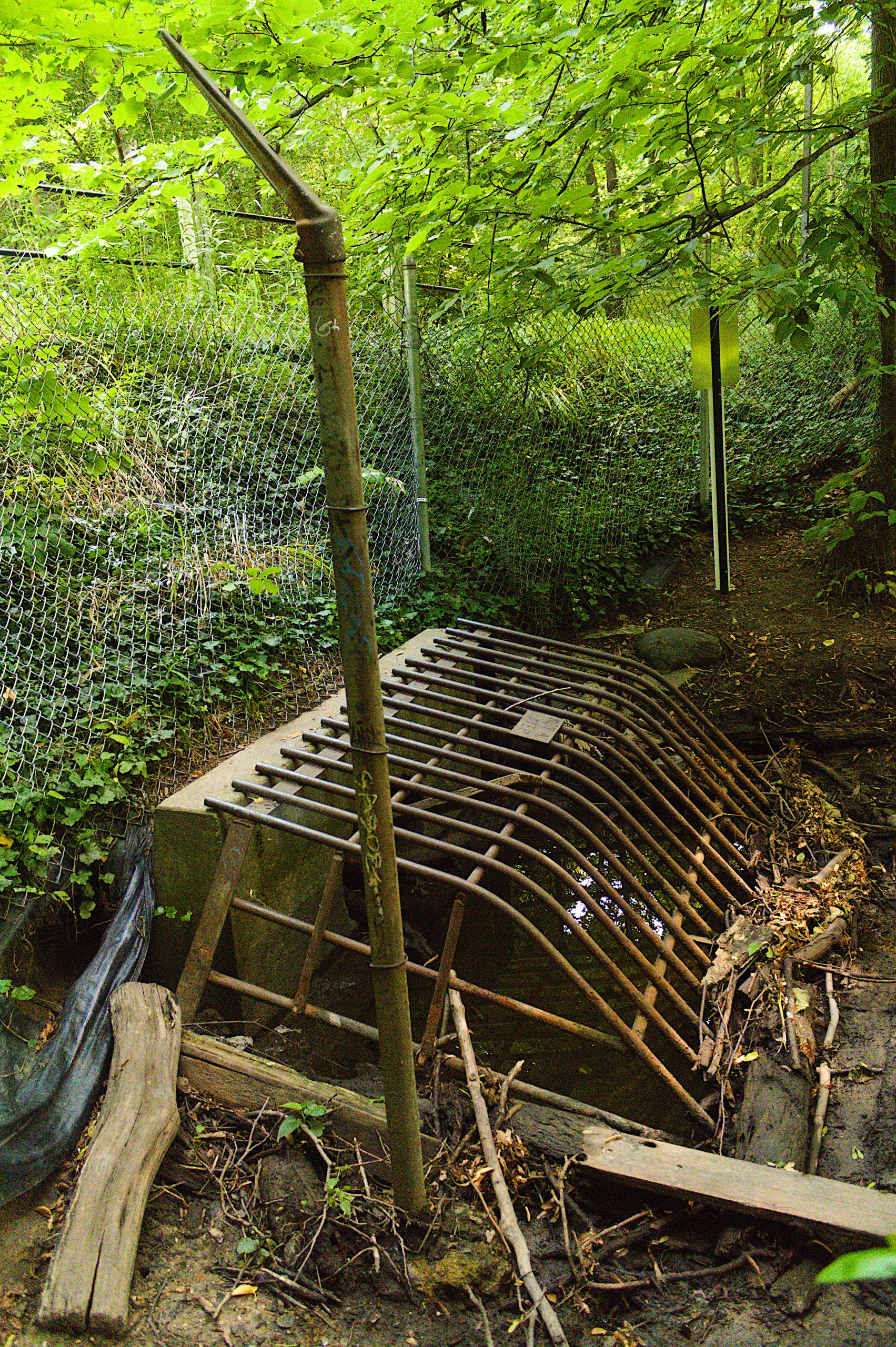
After flowing through through these metal bars, described as prison-like by Mary Lewandowski (9), co-hair of the Coldbrook Creek Community with her husband, Peter Lewandowski. the stream is channeled through miles of underground pipes, built over decades under the feet of Grand Rapidians, only revealed by the sounds emitted from the various manhole covers, such as those recorded for the sound underground project. This includes the site of our next sound-box, the Fulton Street Market. During the warmer months of the year, this roofed corridor is filled with the hustle and bustle of the various shoppers going from stall to stall to stall, browsing wares from various local farmers and artisans, including yours truly last year.
At the bathrooms of this facility, one can find a small green soundbox that describes the creek’s relationship to agriculture. The Coldbrook Creek, while hidden underground, isn’t completely isolated from the surface. When walking on your local sidewalk or even wandering across a parking lot, you might come across a storm drain such as this,
(2)
On top of hosting spooky clowns, these omnipresent yet overlooked elements of civic engineering are places for water to be drained from the street. You see, paved surfaces are different from the soils that proceeded to them. They’re hard and stony, making them very difficult for water to penetrate through into the ground. As a result, streets and walkways would flood if the water was given nowhere else to go. Typically, these storm drains funnel water into underground culverts. For many of the streets, walkways, and paved lots along the subterranean route of the Coldbrook Creek, the culverts that storm drains empty into are the very same that house the creek. This is where another element of human involvement with this creek comes into the conversation; pollution (3).
A massive yet unintended consequence of this system is runoff pollution, which describes the process of water flowing over various surfaces and collecting various types of pollutants, such as oil, pesticides, and soil, and carrying them into various water sources. Another source of this type of pollution, which is the one that the sound underground project focuses on, is agricultural runoff. While the soil that composes an agricultural field is much more porous than a street, water can still run off from it and put pollutants into our water ways. According to the EPA, agricultural runoff is the leading cause of water quality impacts to rivers and streams. One effect that this runoff contributes to is an increase in nitrogen and phosphorous in the water, leading to a swell in the amount of algae that relies on these nutrients. While this may initially sound good, this can lead to a deoxygenation of the water, killing off any fish or other water breathing creatures. Pesticides can poison organisms and sediments can degrade freshwater habitats. These pollutants can also make the water worse for human use by degrading drinking water quality and ruining the recreation value of a body of water (4).
To make matters worse, drains such as the Coldbrook Creek are not truly protected by the clean water act, leaving protection in the hands of local governments. The shear volume of water going straight into the creek as opposed to absorbing into the ground can also present problems with erosion. During a conversation I had with Mary and Peter Lewandowski, they mentioned that during rainstorms water rushes through the culverts of the creek and emerges out at Highland Park, rapidly eroding it’s banks and leaving the trees roots exposed, which are left precariously clinging to the land.
Speaking of Highland Park, that’s the next stop on our tour. In this park, filled with playgrounds, sports fields, and bouldering walls, you can find a small, wooded nature trail. Here, I found what may be one of the most important sights yet on this tour; one of the only remaining sections of creek to see the sun. As proudly proclaimed by a wooden sign atop the large culvert where the creek first emerges from the depths of the earth. You can follow the creek as it flows along the surface, the sunlight glistening of the surface of the water and highlighting the occasional sections where the stream runs over a patch of stones. Combined with the vibrant surrounding vegetation and the sights and sounds of the various local critters, the creek feels almost joyous in it’s escape to the surface — unfortunately, this is a very short lived celebration. Almost as soon as it surfaces, the creek is diverted back underground.
Unlike our first two locations, no box was to be found here. In my conversation with Mary and Pete Lewandowski, Peter mentioned that the sound-boxes at Highland Park and Mary Waters Park were vandalized and stolen. Due to this and the renovations of Canal Park, Peter removed the sound-box there, leading to most of the Sound Underground project being removed from the public space. Ironically, one could view this article as a memorial for a memorial, a digital recollection of a record of the Coldbrook Creek. Fortunately, as mentioned before, all of the audio recordings contained in them are archived of the Coldbrook Creek Community website, meaning that all of the information can still be accessed for education and research. Among other topics, the sound-box speaks of the history of this exposed section of the creek in Highland Park. Back in the day, the park hosted a large lagoon to replace the multiple small ponds that were buried when the creek was culverted. People used to frequently swim in this lagoon until it was eventually closed and buried after accusations of indecent behavior and inappropriate swim attire. This, however, was far from the only site of merriment found on the banks of the Coldbrook. Other pools, such as the Creston Park pool, was filled with water from the creek. This pool was originally a sediment pond, constructed in 1875. With the purpose of helping remove silt from the creek water, this location helps highlight another important interaction humans have had with the Coldbrook Creek; drinking water.
From early on in white American settlement of Grand Rapids, the area was noted for it’s abundance of high quality water springs. While early on households would simply dig a well to obtain their water, the increasingly dense settlement eventually required the need of dedicated water services. This role was first filled by the Grand Rapids Hydrologic Company. Initially working with pipes made of hollowed logs joined by a trained shipwright; the company first sourced water from multiple streams, the Coldbrook Creek being among them, making the creek among the first major water sources for the city. Fire suppression was another important use for the water sourced from the creek. After a number of major fires, the city council voted to establish a city owned water supplier in 1870. The actual plan for the water supply system came from Peter Hogan, who proposed a series of iron pipes to supply water from the Coldbrook, Carrier, and Lamberton creeks (1).
Creston Park is also the subject of our next Sound Underground location, Mary Waters Park. A small urban park, the land is surrounded by neighborhoods, roads, and even a school. It is an environment most certainly urbanized, far from the sort of woodland adventure one might expect in following a creek and one most certainly alien to what the creek would have been found in many years ago, before it got buried under modern American urban planning.
To get to the park, I walked through Creston Plaza, an area of section 8 housing that can be found next to the park. Children were playing in the front yards and adults were enjoying the warm weather on their porches. Walking along the street here, one can tell that this a newer section of the city, with uniform houses bathed in sunlight unobstructed by trees. While the housing development as existed for decades, the current iteration of a neighbor hood was constructed in the mid 2010s (5). This was largely attributed to the frequent flooding of the neighborhood, the result of building the streets and homes over a pond.
In the late 1960’s, the city decided that Creston Park would be replaced by the section of federal housing now referred to as Creston Plaza. This move was heavily protested by the local community, albeit for less than virtuous reasons. According to Sound Underground, “In the late 1960s, as the men of the Creston Heights neighborhood were at work in factories, their wives became a squall of anger and fear. They were enraged that the underutilized park across Lafayette was to be demolished. Yet their thinly veiled cause was to keep public housing out of the neighborhood. Many crusaders readily admitted to this.” (9) While the objections against the park was absolutely laced with classism, such attitudes may have also doomed the park. In an attempt to address the concerns of local citizens, development planners proposed keeping much of the green space of the park and even retaining the pond by shrinking the footprint of the housing units, which would have ultimately only taken 7% of the park land. In response, federal officials rejected the compromise with the expression, “what is this, a resort?” This highlights another issue in this story, the systematic depriving of green space in American urban planning. According to a study conducted by the Trust for Public Lands, parks that serve low income populations were, on average, four time smaller than those serving high income populations (the average sizes being 25 acres and 101 acres, respectively.) Race also becomes a factor in the discussion, with parks in areas composed primarily of people of color being only 45 acres in size and often serving five times as many people as parks in majority white communities, which see an average park size of 87 acres (2).
While no portions of the Coldbrook Creek are visible from Mary Waters Park, a quick detour a few blocks away can reveal a related stream. Walking through a hilly, suburban landscape, one can find themselves at the head of an unmarked gravel trail next to a school bus depot. Unlike the other sections of exposed creek, which are either intentionally maintained for public green space or are protected through either sheer size or human value from being buried, this location is nestled between housing, streets, and maintenance sheds. It has the same mystique of a forested road median or a strip of trees between two properties, a bastion of the natural world existing in spite of, not because of, human interference. In this most unusual site of exploration, one can find a true treasure of an urban landscape; an exposed section of an otherwise culverted waterway.
This, however, is the Carrier Creek. While the Coldbrook has never formally flowed hear, the Carrier Creek ends by merging with it, leading to this being as much a part of the Coldbrook Creeks story as anything else. Here, I find it important to introduce the concept of a watershed. A watershed is a geographic area in which all water eventually flows into a common body, such as a lake or, in this case a stream. As with most natural phenomena, watersheds can be difficult to categorize. Much like a matryoska doll, a watershed can be the sum of many smaller watersheds while, itself, being merely a small part of a gigantic whole. With this, we must explore one of the wholes the Coldbrook Creek is a part of, the Grand River.
The site of interest here is the Coldwater Pumphouse, formerly the city’s oldest water pumping station and still currently home to the Grand Rapids Fire department. The department was out training some new cadets, adding some human life to the scene that would otherwise be found at the adjacent canal park, which was fenced off for renovations. If you look just right over the side of the railing, you can find the large hole in the cement wall separating the land from the water where the Coldbrook into the Grand River, much as the Carrier Creek does the Coldbrook Creek.
While this beautiful river filled with lily pads at first seems to represent a natural alternative to the now mostly artificial Coldbrook Creek, it too is a significantly altered environment. In years past, this would be the location of rushing rapids, some truly grand rapids, one could say. In an effort to better use the river economically and to manage flooding, the city installed a series of dams, which had the side effect of destroying it’s namesake rapids (7). While efforts to reinstate the rapids are ongoing, it is a bit out of scope for this expedition and can be visited later.
As for the sound box tour, this area discusses the creek’s history with the indigenous population of the area. According to the Sound Underground project, the people of the Grand River Bands of Ottawa Indians, members of the Anishinaabe nation, have navigated, fished, and stewarded the waters of Coldbrook Creek for centuries. In 1821, the Treaty of Chicago ceded the land south of the Grand River, including the Coldbrook Creek watershed, to the US federal government. Later, in 1887, the Dawes act, also known as the General Allotment Act, took effect in an effort to farther erode the Ottawa way of life by taking the previously communally owned tribal lands and dividing them up for individual ownership. According to the National Archives, “… It was reasoned that if a person adopted “White” clothing and ways, and was responsible for their own farm, they would gradually drop their “Indian-ness” and be assimilated into White American culture. Then it would no longer be necessary for the government to oversee Indian welfare in the paternalistic ways it had previously done, including providing meager annuities, with American Indians treated as dependents.”(8)
The sound box then goes into the struggles the Grand River Bands of Ottawa Indians have had with getting recognized by the federal government. Beyond the symbolic importance of having their existence institutionally recognized, federal recognition is vitally important for tribal members to receive many important rights and benefits, such as educational benefits, land rights, fishing rights, and hunting rights. Here we hear Ron Yob, chairman of the Grand River Bands of Ottawa Indians, describe his efforts to get recognition through bringing various community members together to gather support and documentation. Notably, he describes how the US government takes issue with evidence for their residence in the area in the 1970s, a single decade of a millennia long history, one that includes the signing of multiple treaties, such as the aforementioned Treaty of Chicago. Unfortunately, as of the publishing of this article, they have yet to receive federal recognition.
In light of the story of the burying of the Coldbrook Creek, one might wonder if a stream can ever be unburied. Daylighting, the process of uncovering a previously culverted and buried stream, answers this question with an affirmative yes. In the report Daylighting Streams: Breathing Life into Urban Streams and Communities by American Rivers, three types of daylighting are recognized: natural, architectural, and cultural. Natural and architectural daylighting both involve physically returning the stream to open air conditions, with natural daylighting describing the process of restoring the stream to a natural state while architectural daylighting being the simple act of putting the open air stream into a constructed channel. Cultural daylighting, on the other hand, describes the act of bringing attention to a culverted stream through artistic or visual markers, such as the Sound Underground project. According to the report, stream daylighting brings with it many benefits. One of these is the restoring of wildlife habitat in developed areas (11). In my exploration of the Coldbrook Creek watershed, I can personally attest to the benefits of exposed creek areas from the various forms of wildlife I encountered, from the bucks I encountered at Carrier Creek to the perched osprey I chanced upon next to the Grand River. While much of humanity may treat it as an afterthought, these creatures value the Coldbrook Creek as an oasis in an extensively built over landscape.
Another benefit of stream daylighting is the fact that daylighted streams are better able to manage flooding then their culverted counterparts. The consequences of poor flood control as a result of this culverting can be seen with Creston Plaza’s frequent flooding issues. Finally, daylighting streams can greatly benefits the local economy through a combination of removing the costs of maintaining culverts and the increased water processing demands they bring and by bringing in increased property values and costumers for local businesses (11).
As for the prospects of daylighting the Coldbrook Creek, there are a few areas that hold the potential for daylighting. From my conversation with the Lewandowskis, one of the most promising candidates for potential daylighting is an extra few hundred feet of the already daylit section at Highland Park. Another location that is actually in talks of being daylit is the section of the stream where it exits into the Grand River by the water works pumphouse (6). While these two seem to be the only promising sites in the foreseeable future of daylighting the Coldbrook Creek, a report from 2015 did recommend daylighting significant portions of the creek if the railroad the runs along much of the path of the creek was to ever shut down (10).
While the Sound Underground project has provided a pretty comprehensive view into the Coldbrook Creek watershed, there are a few areas not covered by the soundbox tour that I feel are important to cover for a proper overview of the water shed. The first has to do with the previously mentioned topic of stream daylighting, being an exposed portion of the Coldbrook Creek that I learned through my conversation with the Lewandowskis; the St. Francis Statue Garden. Managed by the St Francis Statue Garden organization in cooperation with the Grand Rapids Dominican Sisters, who own the land the garden is on. (12)
Another location that is important to mention in this discussion of the Coldbrook Creek is Reeds Lake, one of the primary sources of the Coldbrook Creek. A hot spot for local birdwatchers, Reeds Lake helps to demonstrate the importance of open water sources for the health and wellness of local wildlife. It also serves as a reminder of the tragedies that befell the indigenous peoples here, being named after the man who first bought the land it resides on from the US government.
After all that has been talked about, one question remains; why does this matter? Why go on this grand adventure through the watershed of this small forgotten creek, buried and unseen for decades? Why set up soundboxes through out a city to promote knowledge of a stream? As mentioned a few time through the article, I had the chance to sit down with the Lewandowskis and discuss the Sound Underground project and their work in the Coldbrook Creek watershed. When I asked them what they would answer to the question of why the Coldbrook Creek is important. The answer I got could essentially be summarized in one word; interconnectedness. They said that they wanted the people within the watershed to be aware of the fact that they are connected by this stream. In the first soundbox, all the way back at Wilcox Park, Kate Levy arguably put it best with her observation of the term “watershed moment” — “… what is it that we mean when we say something is a “watershed moment”? A turning point, a key experience in our life? And yet, every inch of this land exists within a watershed. Perhaps, a better definition is when one notices, for the first time, something that has always been there.” (9)
During my interview with the Lewandowskis, they asked me what the angle of my story was. While, at that point, I was still formulating the exact layout of the article, farther research and writing has led me to the conclusion that any story of a watershed has to focus on that watershed moment; the moment when one first discovers what has always been there. A watershed, even one as modest as the Coldbrook Creek watershed, is too vast and complex to be about any one thing. The story of the Coldbrook Creek is a story of wildlife and of Native American tribes living on it’s banks. It’s also a story of a developing city using it for it’s populice and eventually tossing it aside, unaware of it’s benefits. It’s also a story of it’s befoulment with pollution and of the organizations fighting against it. It’s a story of locals setting up soundboxes to remember a forgotten stream and of a journalist telling it’s tale. While you might not live near the Coldbrook Creek, odds are you reside next to a similar story (for example, American Rivers found that 73% of streams in Beltimore, Maryland have been culverted underground). If you’re interested in helping out your local culverted creek, check in with your local environmental orgs and see what they need. Whatever the case, just remember; you’re part of a watershed, connected to countless others that you may never know, so take a moment of have a watershed moment of your own.
If you’re reading this, than you for staying until the end of the article! Special thanks to Peter and Mary Lewandowski for sitting with me for an interview. If you happen to find yourself in the area, the Coldbrook Creek Community hosts six water quality testing events per year, so feel free to stop by and lend a hand!
Last summer, I had the privilege of witnessing one of nature’s greatest spectacles; the emergence of a brood of periodic cicadas. However, this particular event was special, once in a lifetime even; a double brood event, meaning that two cicada broods emerge simultaneously. For this, I made a special expedition to the wilds of Springfield, Illinois due to the fact that it was an area where the two cicada broods overlap.(1) Today, let’s explore what makes these insects so fascinating.
The term “periodical cicada” can actually refer to one of several species of cicada in the genus Magicicada. All native to eastern North America, these insects are well known for their distinctive reproductive cycle. In the beginning, a cicada hatches from an egg typically laid on branches and twigs. Upon hatching, the young cicada will proceed to make their way underground, where they will stay and feed on tree sap for over a decade.(3) For the species M. tredecim, M. neotredecim, M. tredecassini, & M. tredecula, This represents a period of 13 years; they are beat in this regard by M. septendecim, M. Cassini, & M. septendecula, which spend a whopping 17 years underground.(2) After this extensive period of digging tunnels and feeding on plant roots, the cicada will then become a nymph, which sees them digging to the surface and shedding their exoskeletons to develop into their adult form. It is in this adult form that we hear the distinctive calls of the cicada, produced by the males for the purpose of attracting a mate. After mating, the cicadas die off, in which the life cycle starts anew.(3) It should be noted that all species of cicada follow a similar outline for their life cycles, albeit within different time frames.
The method by which these critters create their signature sound is also quite fascinating. Insects, and by extension cicadas, do not posses many of the organs that many vertebrates, such as ourselves, use to produce sound; these include organs such as lungs, tracheas, voice boxes, and tounges. Instead, cicadas have developed the ability to produce noise through a combination of two methods. The first of these methods is through rubbing it’s wings together in a fashion not too dissimilar to the way that crickets rub their legs together to produce their distinct nighttime call. The other method that cicadas use to produce their sound is through the use of an organ known as a tymbal. The tymbal is a series of ribs that cicadas flex to produce sound. To borrow an analogy from Kyle Scheiber, who wrote on behalf of the Peggy Notebaert Nature Museum of the Chicago Academy of the Sciences, “The action is like how a bendy straw makes sound: pulling and pushing the ribs of the bendy straw together makes a series of clicks. If you could push, pull, and twist a bendy straw hundreds of times a second the sound of the clicks would be so close together that you’d only hear a buzzing sound: this is how fast the cicada is able to vibrate its tymbal.”(6)
From the perspective of a large mammal such as ourselves, this may not necessarily seem like an exhilarating subject, the effects can be earthshaking when felt from the emergence of billions of insects, as is what happens with the periodical cicada. When walking through the forest, it felt as though I was immersed in an alien landscape. At all hours of the day, the normal quiet background soundscape of the woods was replaced by the constant droning of billions upon billions of inch long insects, trying to make the most of their short 4–6 weeks on the surface to continue the species. In the branches and stems of the understory the diligent naturalist can find the small exoskeletons left behind by the nymphs when growing into adults, a physical echo of their subterranean life. Even the soil is changed, with any exposed patches becoming a trypophobic mosaic of holes left from the emerging cicadas.
While this special double emergence of overlapping periodical cicada brood was rare, specifically only happening once every 221 years, researchers have studied both it and past periodical cicada events and have found that these small creatures can have significant impacts on the ecosystems they call home. One paper that has been crafted from this research is “Activity responses of a mammal community to a 17-year cicada emergence event” by Alex S Proudman, Landon Jones, Morgan O Watkins, & Elizabeth Flaherty. Published in the Journal of Mammalogy, the researchers used trail cameras and audio recording devices to monitor various mammal species in Northwest Indiana. They found that raccoons significantly changed their behavior in response to the cicadas, indicating that they may have fed extensively on periodic cicadas, while white-tailed deer had a significant decrease in activity, likely due to the noise of the cicadas.(5) Another study conducted to research the effects of periodic cicada is “Influences of a periodical cicada emergence on eastern phoebe reproduction and behavior” by Allison M Klement. In this study, it was found that Sayornis phoebe, or the Eastern phoebe, more rapidly laid second egg clutches, had bigger second clutches, and overall had a more productive breeding season during a periodical cicada event in 2004 as compared to a more typical year in 2005.(4)
Experiencing this once in a lifetime event was one of the best experiences of my life. While much has, rightfully, been made about seeing the great migrations of the Serengeti or the migrations of the titanic baleen whales, the periodical cicada reminds us that the wonder of nature can also be found in the small creatures and places that are often overlooked. It’s a reminder to always be on the lookout for the treasures of the natural world because you never how it’s small things will surprise you in a big way.
5.Proudman, A. S., Jones, L. R., Watkins, M. O., & Flaherty, E. A. (2024). Activity responses of a mammal community to a 17-year cicada emergence event. Journal of Mammalogy, 105(5), 1190–1199. https://doi.org/10.1093/jmammal/gyae062